-
사진
유용한 해양생물 이야기 이미지
-
지식채널
-
논문정보
검색결과 63건
논문정보 목록 - 제목, 내용, 저자, 저널명/발행자, 상세보기 제목 내용 저자 저널명/발행자 상세보기 Ammonia Stress Disturbs Moult Signaling in Juvenile Swimming Crab Portunus trituberculatus Ammonia is a significant concern during hatchery culture in brachyuran species, and its accumulation may lead to abortive moulting and large-scale deaths of the early juveniles. To date, the underlying mechanism for ammonia-induced alteration of the moulting process is still unknown. In this study, we aimed to investigate the effects of ammonia on the moulting as well as the potential mechanisms in early juveniles of the swimming crab Portunus trituberculatus, an important aquaculture species in China. We evaluated the survival rate and moulting rate of the juvenile crabs (C2) and analyzed the expression pattern of the genes in key components of molt signaling during a complete moulting cycle under different concentrations of ammonia nitrogen (the control group: <0.1 mg/L; the LA group: 5 mg/L; and the HA group: 20 mg/L). The results showed that: (1) the survival rate in the LA and HA groups was lower than that in the control group at the end of the experiment, and moulting death syndrome (MDS) was only observed in the HA group; (2) the moulting rate was higher in the LA group and lower in the HA group compared to the control group; (3) consistent with the results of the moulting experiment, MIH showed decreased expression, and genes related to ecdysteroid synthesis, ecdysteroid receptors, and responsive effectors exhibited increased expression in the LA group compared to the control group; and (4) although MIH expression was upregulated, increased expression of the genes associated with ecdysteroid synthesis, ecdysteroid receptors and downstream effectors still observed in the HA group. Our results indicated that low levels of ammonia can promote moulting in juvenile swimming crabs by inhibiting the expression of MIH and activating moult signaling, whereas high levels of ammonia inhibit moulting and lead to MDS through impairing moult signaling.
Wang, Daixia,Liu, Xiaochen,Shang, Yan,Yu, Xuee,Gao, Baoquan,Lv, Jianjian,Li, Jitao,Liu, Ping,Li, Jian,Meng, Xianliang MDPI AG 상세보기 Optimization of Sperm Cryopreservation Formulation in Portunus trituberculatus Portunus trituberculatus is a very important marine economic species, and its aquaculture industry has been developing rapidly. However, the phenomenon of marine wild capture of P. trituberculatus and germplasm degradation has become increasingly serious. It is necessary to develop the artificial farming industry and carry out germplasm resource protection, for which sperm cryopreservation technology is an effective method. This research compared three methods (mesh-rubbing, trypsin digestion, and mechanical grinding) for acquiring free sperm, and the best method was mesh-rubbing. Then, the optimal cryopreservation conditions were selected, and the optimal formulation was sterile calcium-free artificial seawater, the optimal cryoprotectant was 20% glycerol, and the best equilibrium time was 15 min at 4 °C. The optimal cooling program was suspending the straws at 3.5 cm on the liquid nitrogen surface for 5 min and then storing them in liquid nitrogen. Finally, the sperm were thawed at 42 °C. However, the expression of sperm-related genes and the total enzymatic activities of frozen sperm were significantly decreased (p < 0.05), which showed that sperm cryopreservation damaged the sperm. Our study improves the sperm cryopreservation technology and the yield of aquaculture in P. trituberculatus. Additionally, the study provides a certain technical basis for the establishment of a sperm cryopreservation library of crustaceans.
Chang, Le,Lu, Chengpeng,Zhu, Junquan,Chen, Yiner,Wang, Chunlin,Mu, Changkao,Hou, Congcong MDPI AG 상세보기 Molecular identification of an insulin-like peptide from the swimming crab Portunus trituberculatus and evidence for its glucoregulation function Insulin-like peptides (ILPs) are essential to the animal kingdom for regulating growth and development, reproduction, behavior, metabolism, and lifespan. In crustaceans, the most well-known ILP is insulin-like androgenic gland hormone, a key hormone in regulating sex differentiation and reproduction. Identification of other ILPs and their functions are still limited. In this study, an insulin-like peptide gene of the swimming crab Portunus trituberculatus was cloned and characterized. Its transcripts were mainly found in nerve tissues and expression could be induced by glucose, implying a putative role in glucoregulation. After depletion of endogenous ILP, injection of ILP dsRNA (dsILP) significantly elevated blood glucose levels and recombinant ILP (rILP) decreased hemolymph glucose levels, further clarifying the involvement of acquired ILP in hemolymph glucose regulation. Injection of dsILP decreased PtAkt, PtGS, PtPFK and increased PtGSK and PtPEPCK gene expression. The opposite profile was observed after glucose and rILP injection, indicating that PtILP might negatively regulate hemolymph glucose levels via the IIS (insulin/IGF-1 signaling) pathway by inhibiting gluconeogenesis and promoting glycogen synthesis and glycolysis. This study has refined the mechanism of glucose regulation in crustaceans and laid the foundation for further studies on ILP function.
Xu, Rui,Wang, Meng-en,Tu, Shisheng,Xie, Xi,Zhu, Dongfa Frontiers Media SA 상세보기 Effects of Different Habitat Space on Growth Performance and Nutritional Composition of Swimming Crabs (Portunus trituberculatus) Habitat space is crucial for animals. This experiment explored the effect of four different farming acreages (0.5 m2, 1 m2, 10 m2, and 100 m2) on survival rate, growth performance, and muscle nutrition composition of swimming crabs (Portunus trituberculatus) at the farming density of 2 ind/m2. The results showed that the survival rate of the crabs that live in the 10 m2 group and live in 0.5 m2 alone had the highest survival rate of 20.50% and 20%, better than the 1 m2 group and the 100 m2 group with the lowest of 12.00% and 13% (
$ P @@\symbol{@@@@3C} @@ 0.05 $ ). There was no significant difference between final body weight and final carapace width among the 4 groups ([FORMULA OMISSION]). The crude lipid content was the highest in 1 m2, which was significantly higher than in 0.5 m2 ([FORMULA OMISSION]). The crude protein content in the 1 m2 and 10 m2 groups was significantly higher than that in the 0.5 m2 and 100 m2 groups ([FORMULA OMISSION]). The results of the three conventional nutrients showed that there was no positive correlation between the muscle conventional nutrients and the farming area. The polyunsaturated fatty acid part of the 100 m2 and 10 m2 group was significantly different from the 1 m2 and 0.5 m2 groups ([FORMULA OMISSION]). The results show that farming crab alone is not better than together, and a small aquaculture acreage helps to improve the muscle nutrition composition of the swimming crabs, while a large aquaculture acreage is more conducive to balance the development of nutrition. Overall, 10 m2 of habitat space was more economically feasible in practice.Yan, Shiyu,Mao, Shuang,Xia, Qing,Cui, Zhenquan,Duan, Haibao,Ren, Guoliang,Li, Xiaoying,Ge, Hongxing,Liu, Meimei,Dong, Zhiguo Hindawi Limited 상세보기 Survival, Energy Status, and Cellular Stress Responses of the Juvenile Swimming Crab Portunus trituberculatus under Acute Nitrite Stress Nitrite is a common pollutant encountered in aquaculture systems. During intensive hatchery, accumulation of nitrite can cause massive mortality of juvenile crustaceans. However, the nitrite toxicity and cellular stress responses in juvenile crustaceans is not clearly understood. Here, we investigate the survival, energy metabolism, and cellular stress responses in juvenile P. trituberculatus, an important aquaculture species in China, under acute nitrite stress. The results revealed nitrite resulted in a significant decrease in survival rate of juvenile swimming crab. After nitrite exposure, the activity of catabolic enzymes, such as HK, PK, CS, and CPT-1, were initially enhanced, and then they showed significant decrease at the late stage of exposure, accompanied by reduction in ATP and adenylate energy charge (AEC). The impaired energy homeostasis was possibly associated with disturbed AMPK signaling and enhanced anaerobic metabolism, which was indicated by the high levels of LDH activity and HIF-1α expression. Furthermore, we found that nitrite stress can depress antioxidant systems and unfold protein responses, causing oxidative damage and endoplasmic reticulum (ER) stress, and this, in turn, can trigger autophagy and apoptosis through both caspase-dependent and caspase-independent pathways. The results of the present study improve our understanding regarding adverse effects of nitrite on P. trituberculatus and provide valuable information for hatchery management.
Liu, Xiaochen,Wang, Daixia,Shang, Yan,Yu, Xuee,Gao, Baoquan,Lv, Jianjian,Li, Jitao,Liu, Ping,Li, Jian,Meng, Xianliang MDPI AG 상세보기 -
특허정보
검색결과 33건
특허정보 목록 - 제목, 등록/출원번호, 출원인, 원문정보 제목 등록/출원번호 출원인 원문정보 폐기 꽃게와 한약재를 이용한 농업용 비료의 제조 방법 2012-0010010 인천광역시 (인천광역시수산자원연구소장) 원문정보 꽃게 껍질을 이용한 천연 조미료의 제조방법 및 이에 따라 제조된 꽃게 껍질 천연 조미료 1020210041229 이슬|주식회사 빙고씨푸드 원문정보 대게빵 또는 꽃게빵 및 이를 성형하기 위한 성형틀 1020120114928 백상덕 원문정보 꽃게살 분리장치 및 이를 이용한 분리방법 1020110132922 한국식품연구원 원문정보 꽃게와 오징어를 이용한 기능성 김치 및 그것의 제조방법 1020100114920 주식회사 대복 원문정보 -
유용한 해양생물 이야기
검색결과 1건
유용한 해양생물 이야기 목록 - 학명, 국명, 생리활성, 원료등록, 특징/이용 학명 국명 생리활성 원료등록 특징/이용 Portunus trituberculatus 꽃게 항산화 식품원료 등록 식품원료 등록
-
LOADING
대용량 데이터의 경우 시간이 소요될 수 있습니다.
생물종 상세정보
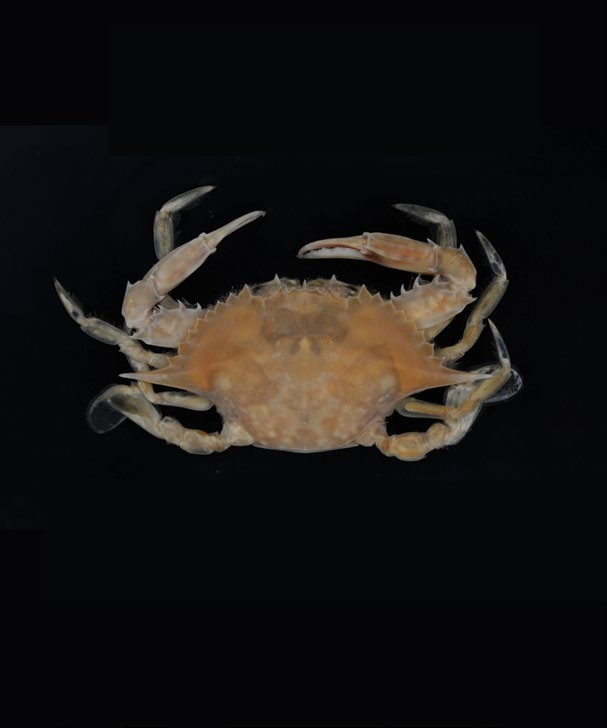
꽃게Portunus trituberculatus (Miers, 1876)
- 해양생물평가등급
-
소개
종설명(Description)
-
갑각은 초록색을 띤 연한 청색이거나 짙은 청색이고, 집게다리에는 보라색 바탕에 흰점무늬가 있다. 남해안에서는 몸 전체가 보라색인 개체도 흔히 나타난다. 이마에는 3개의 작은 이가 있으나 노령의 개체에서는 중간의 것이 없어져 2개로 보이기도한다. 최대 갑각나비는 200mm 정도이다.
-
수심 2~110m의 모래나 모래진흙 바닥에 서식한다. 포란기는 4~8월이며, 조에아유생 4기를 거치고 수명은 약 3년으로 추정된다.
-
우리나라 서해, 남해 전역
-
일본, 중국(보하이해, 동중국해, 남중국해)
-
참고문헌
홍성윤. 2006. 한국 해양 무척추동물 도감. 아카데미서적. 4790pp.
해양생명자원 기탁등록보존기관(1단계 3차년도)
Miers, E.J. 1876. Descriptions of some new species of Crustacea, chiefly from New Zealand. Annals and Magazine of Natural History. ser 4 (17), 218-229.
Spiridonov, V. A.; Neretina, T. V.; Schepetov, D. 2014. Morphological characterization and molecular phylogeny of Portunoidea Rafinesque, 1815 (Crustacea Brachyura): Implications for understanding evolution of swimming capacity and revision of the family-level classification. Zoologischer Anzeiger - A Journal of Comparative Zoology. 253(5): 404-429.
김원,김훈수. 2001. 유용게류. 한국생명공학연구원. 95-97.
등급정보 : 1등급
안전성, 공급성, 유용성, 경제적, 생태적, 학술적, 최종등급 안전성 공급성 유용성 경제적 생태적 학술적 최종등급 - - - 1 3 3 1 공간정보
염기서열정보(Sequence)
NCBI (Portunus trituberculatus)
COI
염기서열
-
-
자원정보
-
대내외 연계 정보
LOADING
대내외 연계 정보 데이터를 불러오는 중입니다.