-
사진
유용한 해양생물 이야기 이미지
-
지식채널
-
논문정보
검색결과 16건
논문정보 목록 - 제목, 내용, 저자, 저널명/발행자, 상세보기 제목 내용 저자 저널명/발행자 상세보기 Cell-free 시험법에서 가는갯능쟁이 메탄올추출물의 항 주름 및 피부미백 효능 The purpose of this study was to examine the inhibitory efficacy of Atriplex gmelinii methanol extract (AGME) against wrinkle formation and hyperpigmentation in a cell-free system. The total polyphenol and flavonoid contents of AGME were 268.7 tannic acid equivalent (TAE) mg/g and 247.5 rutin equivalent (RE) mg/g, respectively. At a concentration of 1,000 μg/mL, the electron-donating ability of AGME was 83.2% with an SC50 (50% scavenging concentration for free radicals) of 249.0 μg/mL. The IC50 (50% inhibitory concentration) of collagenase activity for AGME and ascorbic acid was over 1,000 μg/mL and 448.3 μg/mL, respectively. The IC50 of elastase activity for both AGME and ascorbic acid was over 1,000 μg/mL. The IC50 of mushroom tyrosinase activity for AGME and arbutin were less than 62.5 μg/mL and 175.3 μg/mL, respectively. The results of this study demonstrate that AGME has high antioxidant capacity as well anti-wrinkle and skin-whitening efficacies in a cell-free system. 전근영,김영철 상세보기 Importance of Biotic and Soil Factors in Determining the Distribution Strategies of Coastal Salt Marsh Plants The distribution of plant communities in the salt marshes of the southwestern coasts of South Korea was studied, along with environmental or plant factors, by canonical correspondence analysis (CCA) and the competitor (C), stress tolerator (S), and ruderal (R) (CSR) ecological strategies. The coastal salt-marsh plants were classified into three plant-factor groups in the CCA biplot diagram. Group 1 was correlated with LS and FP. Group 2 was correlated with CH and SLA, and Group 3 was correlated with LA, LDMC and LDW. The salt-marsh plants were classified into four soil-factor groups in the CCA biplot diagram. First, the group factor was correlated with TN, TOC, and Ca2+. Second, the group factor was distributed according to Mg2+, soil texture as Clay and Silt. Third, the group factor was distributed according to Salinity and Na+ content. Fourth, the group factor was distributed according to Sand content. To clarify the relative significance of competition, stress, and disturbance in the distribution process of plant communities, the CSR distribution model was adopted. The nine species showed CR (competitor-ruderal) strategies: Artemisia fukudo, Artemisia scoparis, Aster tripolium, Atriplex gmelinii, Imperata cylindrica var. koenigii, Salicornia europaea, Suaeda japonica, and Suaeda maritima. The four species with C (competitor) strategies were Artemisia capillaris, Limonium tetragonum, Triglochin maritimum, and Zoysia sinica. Carex scabrifolia and Phragmites communis displayed SC (stress-tolerant-competitor). Both distribution patterns of the CCA diagrams and CSR triangles may provide a useful scientific basis for protecting and restoring salt marshes and their valuable ecosystem services, considering the increasing disturbances.
Son, Dong-Ho,Lee, Jeom-Sook,Kim, Da Eun,Lee, Seung Ho,Hong, Sun-Kee,Myeong, Hyeon-Ho,Cho, Jang-Sam,Lee, Jae-Choon,Lee, Jae-Young,Seon, Hwi Joon,Kim, Jong-Wook Shima Publishing 상세보기 In vitro screening of elastase, collagenase, hyaluronidase, and tyrosinase inhibitory and antioxidant activities of 22 halophyte plant extracts for novel cosmeceuticals Background: Halophyte plant (HPs), a salt-resistant flora, has been reported to provide several health benefits, but the knowledge of its cosmeceutical potential is still ambiguous. Here, 70% ethanol extracts of 22 HPs collected from along the coast of South Korea were investigated for their potentials of antioxidant, anti-aging, and whitening properties for use as materials in novel cosmeceuticals.Methods: Antioxidant activities were determined by DPPH (1,1-diphenyl-2-pricrylhydrazyl) free radical and hydrogen peroxide scavenging assays, and skin aging-related enzyme activities (anti-elastase, anti-collagenase, antihyaluronidase, and anti-tyrosinase) were evaluated by using the spectrophotometric method.Results: Among the 22 HPs, we found that Ischaemum antephoroides f. coreana and Atriplex gmelinii extracts presented the strongest scavenging effects against DPPH free radical and hydrogen peroxide, respectively. Our finding additionally suggested that Salicornia europaea extract might provide a major source of anti-elastase and anti-hyaluronidase; meanwhile, Rosa rugosa extract showed the highest anti-collagenase effect. Furthermore, the highest tyrosinase inhibitory activity was possessed by Spartina anglica extract.Conclusion: These findings may suggest that halophyte plants showing biological activities may be potent inhibitors of tyrosinase, elastase, collagenase, and hyaluronidase and could be useful for application in cosmeceuticals. Chanipa Jiratchayamaethasakul,Yuling Ding,Ouibo Hwang,Seung-Tae Im,Yebin Jang,명승원,Jeong Min Lee,김현수,Seok-Chun Ko,이승홍 한국수산과학회 상세보기 3,5-Dicaffeoyl-epi-quinic acid inhibits the PMA-stimulated activation and expression of MMP-9 but not MMP-2 via downregulation of MAPK pathway Abstract
Matrix metalloproteinases (MMPs), especially MMP-2 and MMP-9, are very important gelatinases that are overexpressed during tumor metastasis. Up to date, several MMP inhibitors have been developed from natural sources as well as organic synthesis. In the present study, the MMP-2 and MMP-9 inhibitory effects of 3,5-dicaffeoyl-epi-quinic acid (DCEQA), a caffeoylquinic acid derivative isolated from Atriplex gmelinii, were investigated in phorbol 12-myristate 13-acetate (PMA)-treated human HT1080 fibrosarcoma cells. Gelatin zymography and immunoblotting showed that DCEQA significantly inhibited the PMA-induced activation and expression of MMP-9 but was not able to show any effect against MMP-2. DCEQA treatment was also shown to upregulate the protein expression of tissue inhibitor of MMP-1 along with decreased MMP-9 protein levels. Moreover, the effect of DCEQA on phosphorylation of mitogen activated protein kinases (MAPKs), analyzed by immunoblotting, indicated the DCEQA inhibited the MMP-9 by downregulation of MAPK pathway. Collectively, current results suggested that DCEQA is a potent MMP-9 inhibitor and can be utilized as lead compound for treatment of pathological complications involving enhanced MMP activity such as cancer metastasis.
Lee, Jung Im,Kil, Jung-Ha,Yu, Ga Hyun,Karadeniz, Fatih,Oh, Jung Hwan,Seo, Youngwan,Kong, Chang-Suk De Gruyter 상세보기 Transformation and Expression of Na+/H+ Antiporter Vacuolar (AgNHX1) Gene in Potato (Solanum Tuberosum L.) Plants Under Salt Stress soliman hemaid Ibrahim,Kadasa Naif M S 상세보기 -
유용한 해양생물 이야기
검색결과 1건
유용한 해양생물 이야기 목록 - 학명, 국명, 생리활성, 원료등록, 특징/이용 학명 국명 생리활성 원료등록 특징/이용 Atriplex gmelinii 가는갯능쟁이 항산화
-
LOADING
대용량 데이터의 경우 시간이 소요될 수 있습니다.
생물종 상세정보
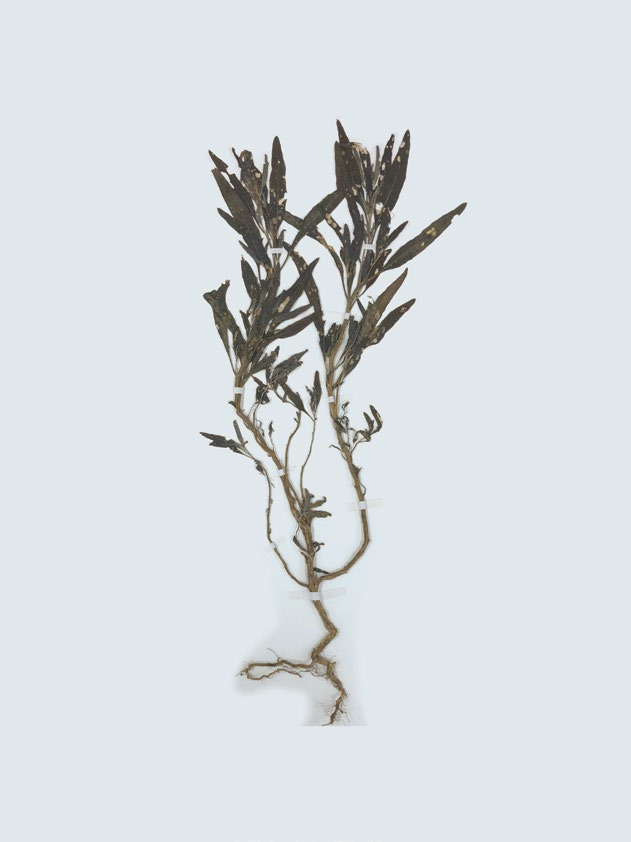
가는갯능쟁이Atriplex gmelinii C.A.Mey. ex Bong., 1833
- 해양생물평가등급
-
소개
종설명(Description)
-
줄기는 여러 개가 올라와 위로 곧게 자라며, 가지가 많이 갈라지고 세로줄이 뚜렷하다. 잎은 어긋나며 피침형 또는 선형으로 두껍고 어릴 때 비늘털이 많다. 잎 끝은 뾰족하고 가장자리는 밋밋하다. 꽃은 7~8월에 피며, 줄기와 가지 끝에서 이삭꽃차례로 촘촘히 달리고 한 이삭에 수꽃과 암꽃이 섞여 나는 암수딴꽃이다. 수꽃은 4~5장의 꽃덮개와 4~5개의 수술을 가지며, 꽃밥은 노란색이다. 암꽃에는 2개의 세모꼴 꽃싸개가 있으며, 암술대는 2개다. 열매는 낭과며, 꽃싸개에 싸여 있고 씨앗은 검은색으로 광택이 있다.
-
만조선 밖 모래땅이나 간척지 등에 자라며, 높이가 30~70㎝정도인 한해살이풀이다.
-
전 해안에 분포
-
러시아(캄챠카), 일본, 북아메리카
-
참고문헌
정태현, 도봉섭, 심학진. 1949. 조선식물명집.
이창복. 2003. 원색대한식물도감. 향문사. 하; 797~840.
원정혜, 김경미, 김성환, 이민수. 2022. 우리나라 바다꽃식물. 국립해양생물자원관. 343pp.
등급정보 : 2등급
안전성, 공급성, 유용성, 경제적, 생태적, 학술적, 최종등급 안전성 공급성 유용성 경제적 생태적 학술적 최종등급 2 1 2 - - - 2 공간정보
염기서열정보(Sequence)
NCBI (Atriplex gmelinii)
ITS
염기서열
-
-
자원정보
-
대내외 연계 정보
LOADING
대내외 연계 정보 데이터를 불러오는 중입니다.